
Most manufacturers already know digital transformation matters. The hard part is the business case. Here is a practical framework for building one your board will sign off, plus a free 10-minute way to find your starting point.
Across the Midlands, manufacturers face the same squeeze: rising input costs, tighter margins, a stubborn skills shortage, and customers who expect more visibility and faster delivery. Industry 4.0, smart factory, IIoT, automation, data analytics - the labels keep changing, but the boardroom question stays the same. Is it worth it, and where do we actually start?
The honest answer is that digital transformation tends to fail when it starts with technology, and succeed when it starts with a clear business case. Here is how to build that case.
Current state: manual, disconnected, reactive
Most factories run on a mix of experienced people and spreadsheets. Machines hold data they never share. Planning is done the night before and reworked by lunchtime. Maintenance happens after something breaks. Quality issues are found at the end of the line, not the moment they occur. None of this is a failure of effort. It is simply the ceiling of what a disconnected, reactive operation can do.
Future state: connected, automated, predictive
A digitally mature operation looks different. Machines, sensors and business systems share a single source of truth. Schedules are optimised in seconds, not overnight. Maintenance is predicted before failure. Quality variance is caught in real time. Leaders model "what if" scenarios before committing capacity. The goal is not technology for its own sake, it is fewer surprises and better decisions.
The five questions every leadership team asks
1. What is the ROI on digital initiatives? ROI comes from three places most factories can measure today: reduced unplanned downtime, higher Overall Equipment Effectiveness (OEE), and increased throughput from the assets you already own. The key is to spend where return is fastest, which is why a maturity baseline matters before any capital is committed. KFactory reports outcomes such as up to 35% operational cost reduction and a 23.4% throughput increase across deployments.
2. How does this fit with our existing systems? This is a connectivity question, not a rip-and-replace one. The right approach integrates with what you run now, including PLC, OPC UA, Modbus and MQTT on the shop floor, and ERP, WMS and PLM in the back office. You are adding an intelligence layer on top of existing investment, not throwing it away.
3. What skills do we need on our team? Digital maturity is as much about people as platforms, which is why team digital literacy, leadership mindset and change readiness should be assessed honestly at the start. Modern platforms also reduce the reliance on scarce specialists through AI agents and "virtual engineers" that handle analysis your team would otherwise need a data scientist for.
4. What is the implementation risk? Risk is highest when transformation is treated as one big-bang project. It drops sharply when you start with a diagnostic, prove value on a single line or cell, and scale from evidence. KFactory cites implementation in around 4 weeks rather than the typical 4 to 12 months, precisely because the rollout is phased.
5. How do we scale beyond a pilot? A pilot becomes a programme when it is modular and measurable. Connect one priority line, prove the OEE and downtime gains, then extend the same connected-and-predictive model across lines and sites, adding planning, analytics and autonomous optimisation as maturity grows.
A realistic roadmap
- Phase 0 - Diagnose. Establish a baseline of where you are across connectivity, analytics, people and process. This is the assessment here.
- Phase 1 - Connect. Get data flowing from one high-value line or cell.
- Phase 2 - Operate. Add real-time monitoring, OEE analysis and predictive maintenance on that line.
- Phase 3 - Plan and Analyse. Optimise scheduling, run what-if scenarios, and roll out across the plant.
- Phase 4 - Accelerate. Introduce AI agents and autonomous optimisation, then extend across sites.
Investment versus value
Phased delivery means each stage funds the next. The early wins in downtime and OEE typically pay for the deeper rollout, so you are not asking the board for a single large bet with a distant payback. You are asking for a first step with a measurable return, then a decision to continue based on evidence.
Risk mitigation in one line
Start small, integrate rather than replace, set a measurable milestone for every phase, and track progress against the baseline from your diagnostic so the gains are never in doubt.
Proof from similar manufacturers
KFactory's published results with manufacturers include:
- Dacia-Renault (SILDVB), automotive stamping - 10% productivity increase
- Sauter, precision engineering - 5% OEE increase
You can read more of these on the KFactory website.
Start with the free 10-minute assessment
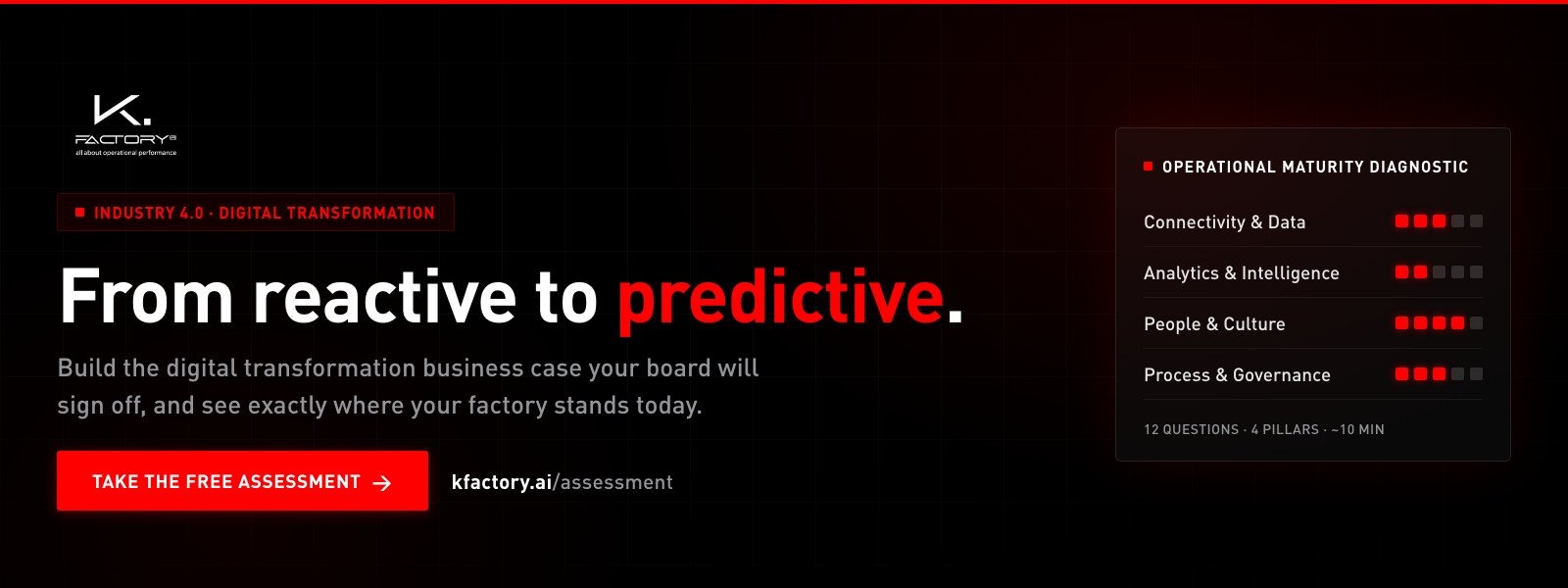
The lowest-risk first step is to find out exactly where you stand. KFactory's free Operational Maturity Diagnostic is a short, scenario-based assessment - 12 questions across four pillars (Connectivity & Data Collection, Analytics & Intelligence, People & Culture, and Process & Governance), each scored from "Informal" through to "Optimised".
You get your scores for every pillar, a gap analysis showing your highest-leverage improvement areas, and the option of a personalised readiness report with prioritised recommendations and a suggested roadmap delivered as a PDF.
Take the assessment and let's talk about the score!
- Cristina Dima, team KFactory